
DSP - Problem Management
January 2026 - V1.3
Kevin Blackshaw - Group Head of Service Management
Review Cycle - Annually - Q3
Contents
- Document Control
- Section 1 - Introduction
- Section 2 - What is Problem Management?
- Section 3 - Usage of Problem Management
- Section 4 - Incident or Problem?
- Section 5 - Reactive and Proactive Problem Records
- Section 6 - Known Error?
- Section 7 - High Level Problem Process
- Section 8 - The Advantages of Problem Management at DSP?
- Section 9 - Creating and Managing a Problem Record
- Section 10 - Scope of Problem Management at DSP?
- Section 11 - Problem Management Templates
- Appendix: Problem Management and ITIL (V3.0 / V4.0)
Confidentiality and Copyright
The information contained in this document is confidential and is issued by DSP on the understanding that it will be used only by the staff of, or consultants to, the Client and where consultants are employed, the use of this information is restricted to use in relation to the business. In particular, the contents of this document may not be disclosed in whole or in part to any other party without the prior written consent of DSP © - Database Service Provider Global Limited. All rights reserved.
Validity of Information
DSP has made every effort to ensure that all statements and information contained herein are accurate as per the document release date. Any questions regarding the content of this document should be directed to our Service Delivery Department - ServiceDesk@dsp.co.uk
Change Control
| Version | Date | Update | Owner |
|---|---|---|---|
|
1.0
|
01/10/2022
|
Process Live / Staff Training Completed
|
KB
|
|
1.1
|
01/05/2025
|
Problem Process Updated to reflect new ITSM toolset - no change to web page
|
KB
|
|
1.2
|
24/11/2025
|
Email addresses amended following the introduction of Ivanti Neurons / new ITSM toolset. Process amended to indicate Problem Records are now visible to all DSP customers. Section 11 added for consistency.
|
KB
|
|
1.3
|
21/01/2026
|
Update to Section 2 - Providing clarity on who can raise PRB Records and How DSP Prioritise PRB Records
|
KB
|
Process Review
| Reviewers | Date | Update | Owner |
|---|---|---|---|
|
KB
|
03/10/2023
|
Additional Staff Training Completed - No changes to Process
|
KB
|
|
KB
|
30/09/2024
|
No update - likely amendments - Q2 - 2025
|
KB
|
|
KB
|
01/05/2025
|
Process Reviewed Minor Amendments to reflect new ITSM toolset - no change to web page content
|
KB
|
|
KB
|
24/11/2025
|
Annual Process Review - Email addresses amended following the introduction of Ivanti Neurons / new ITSM toolset. Process amended to indicate Problem Records are now visible to all DSP customers.
|
KB
|
|
KB
|
20/01/2026
|
Ad-Hoc Review in line with audit requirements. Section 2 Updated (See Change History)
|
KB
|
Section 1 - Introduction
Welcome to the DSP family, we offer award-winning IT consultancy and managed services for Oracle, Microsoft and Google technologies. We specialise in data platform management, application development, engineered systems and Cloud with a strong presence in Oracle RDBMS, OCI, Exadata, SQL Server, Azure, APEX, and GCP. DSP is a leading technology partner in the UK and has been recognised for that by our technology partners and industry through a wide range of awards and accolades.
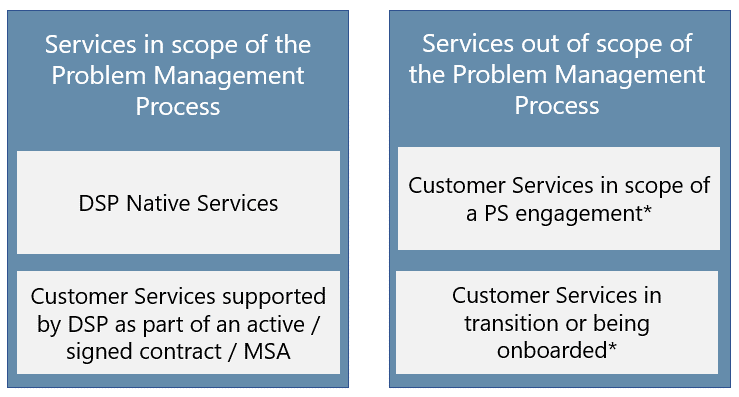
As a DSP Managed Services Customer – DSP Offer a range of ITIL based processes to provide Customer Excellence and a standardised our approach to IT Service Management offering. The following document is a brief overview of Problem Management and how the Problem Management Process works at DSP. While offered as a default component of our Managed Service, both Professional Service customers and those customers undergoing Transition (onboarding) can access Problem Management on request via their Account Manager.
Section 2 - What is Problem Management?
Problem Management seeks to minimise and adverse impact of Incidents by preventing Incidents from happening. For Incidents that have already occurred, Problem Management works to prevent these Incidents from happening again.
ITIL defines a "Problem" as "the underlying cause of one or more Incidents"
Problem Management works closely with Incident Management, but it is not the same:
- Incident Management is about restoring services as quickly as possible (and within SLA) to ensure business continuity, sometimes by applying temporary solutions (workaround)
- Problem Management is tasked with analysing root causes and preventing Incidents from happening in the future
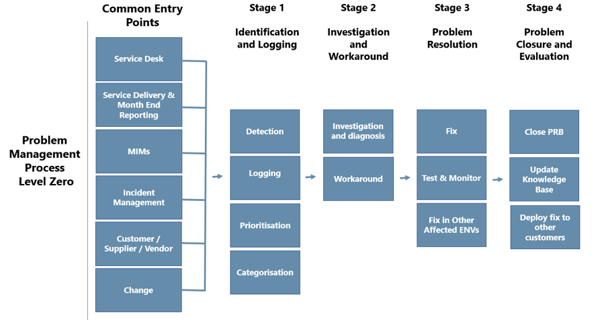
All Problems should be logged by DSP Team Members on behalf of the DSP customers as Problem Records (PRB Records) within DSP's ITSM (Cherwell) toolset, where their status can be tracked, and a complete historical record maintained.
Who can raise PRB Records?
While DSP Customers can view and update PRB Records from with the DSP ITSM Portal the creation of PRB records is restricted to DSP Staff Members. However, DSP customer can request a PRB record via an update on another ticket (such as a request for Root Cause Analysis). Alternatively customer can discuss the need for a PRB record as part of their regular meeting cycle.
Are Problem Record Progress Updates Included in DSP Service Reviews?
Yes, DSP present updates on PRB records (along with Incident / Request and Change) as part of the Service Review Process.
How do DSP categorise and Prioritise Problem Records?
The categorisation and prioritisation should be is uniformed with the approach used in Incident Management, to facilitate matching priorities between Incidents and Problems wherever possible. However – additional factors should be considered specific to Problem Management when determining the initial or changing the severity / priority of a Problem Record –
P1 = High risk of unmitigated recurrence of significant P1/P2 Incident if this action is not resolved where it is known the incident will remove critical services or business processes affecting the whole business or customer. The desired action is to directly address a root cause which will either completely prevent such incidents from recurring or greatly reduce their impact to a negligible level. Workaround / significant mitigation unavailable. Root Cause likely unknown.
P2 = Medium / high risk of unmitigated recurrence of a high priority P2 incident if this action is not resolved where it is known the incident will remove critical services or business processes affecting a key department, business process or subset of customers. The action directly addresses the root cause and will either significantly mitigate the impact of a recurrence or have a high chance of preventing a recurrence. Workaround or mitigation could be available but untested / inconsistent or time consuming to enact. Root cause may or may not be known but impact of repeat incident is less than a P1 (whole company / Production / All Customers).
P3 = Medium risk of recurrence of the incident but mitigated. The mitigation may not be optimised or a permanent fix. Root Cause likely to be known. No customer impact likely only affecting an internal department, function or process. Issue not likely Production availability impacting.
P4 = Low risk of recurrence of the incident but mitigated. The mitigation may not be optimised or a permanent fix. Root Cause known. No customer impact only affecting an internal user department, function or process. Issue not Production availability impacting.
Section 3 – Usage of Problem Management
Examples of where the Problem Management process can be invoked for DSP or Customer events (usually incidents) that are –- Mitigated but not resolved (service has been returned via a workaround but the issue is not fixed)
- Re-occurring / intermittent
- Performance issues where the Root Cause (RC) is unclear
- Events where a Root Cause Analysis (RCA) is required by either DSP or the customer (i.e. following a Major Incident)
Section 4 – Incident or Problem?
4.1 - Incident Management
- Fixed in Real Time
- Aim to restore service as priority
- Workarounds acceptable
- SLA Driven
- About the here and now
4.2 - Problem Management
- Aims to prevent incidents in the future (or reduce impact)
- Contains RCA (especially for Major Incidents)
- Underlying cause of 1 or more INCs
- Not SLA Driven
- About the future
Section 5 - Reactive and Proactive Problem Records
The Problem Management process uses reactive as well as proactive approaches:
- Reactive Problem Management is triggered if issues are identified that require analysis and the deployment of a longer-term solution (not workaround) or an explicit RCA (such as a Major Incident). For example, Problem Management may pick up an Incident, or a set of related Incidents, whose root cause could not be resolved during Incident Management, to prevent similar Incidents from recurring.
- Proactive Problem Management is an ongoing activity that tries to identify issues to prevent resulting Incidents from happening. For example, Problem Management will analyse Incident Records, operational logs, periodic Health Checks etc. to find patterns and trends that may indicate the presence of underlying errors.
Section 6 - Known Error?
Not all problem records can be closed as successfully resolved. Reasons can include –
- Event did not re-occur / insufficient information to investigate
- Solution is cost based and either the customer or DSP could not warrant the return on investment (ROI)
- Workaround in place / inability to progress investigation
- RC cannot be determined
-
Less Incidents
-
Time to resolve issues once a service has been returned
-
Less Resolution SLA Breaches (Root Cause Analysis should not occur in an Incident Ticket)
-
A more rounded service allowing us to distinguish incidents from problems
-
Solutions that can be deployed to multiple customers levelling up all customers and not customers in isolation
Section 9 - Creating and Managing a Problem Record
- Problem records can only be created by DSP Team members in agreement with Customer representatives and not directly by customers or vendors.
- A customer can request a problem record either by updating one or more customer ticket or by contacting the Service Delivery Team or their relationship owner.
- Problems are then assembled into a PRB Register and discussed in a Problem Forum (this can be combined with Service Review Meetings / Incident Review Meetings or CSIP Meetings as required to ensure the volume and frequency of meetings meets the customer’s needs.
- All Problem records are raised and updated within DSP’s ITSM Toolset (Neurons and are visible via the customer dashboard - https://dspgroup-ism.ivanticloud.com/)
*As part of DSP’s service offering a customer’s service may be accessed as part of Project Services (PS), Managed Services (MS) or as part of Service Transition and Onboarding Services. By default, services accessed by DSP customers as part of PS or Onboarding/Transition Services are not in scope of the PRB Management Process.
However, if escalated the PRB process can be used to help structure DSP Problem resolution activity while being excluded from service availability, response and resolution SLAs for those services not presently covered under a Managed Service Agreement (MSA) / MS Contract.
Appendix: Problem Management and ITIL (V3.0 / V4.0)
- In ITIL V3.0 - Problem Management was one of 26 Service Lifecycle Processes. Problem Management was a Process within the Service Operation stage of the Service Lifecycle
- In ITIL V4.0 - Problem Management remains an important part of the framework and is now part one of the 34 Management Practices and resides with General Management Practices
Did you know we do more than Managed Services?
Meet the Customer Excellence Team
At DSP, we have a dedicated team to ensure our customers are happy with the service we're providing. If you'd like to meet with the team, get in touch today!


.png?width=250&height=56&name=stonewater-logo%20(1).png)